Get a Clue! Plot Your Next Mystery with Fleur Bradley
Table of Contents Show
Ten-year-old me didn’t know the Dewey Decimal System, but I could find my library’s Nancy Drew and Hardy Boys books in the dark.
Soon, I found my way to Agatha Christie, Arthur Conan Doyle, and others who quietly added brick after brick to my foundation as a writer. Put this way, it’s probably no surprise to you that I write a lot of mysteries, but this is only something I’ve just realized in the past year, and I’m just as shocked by this revelation as one of the people gathered into the living room for Poirot’s reveal of the culprit.
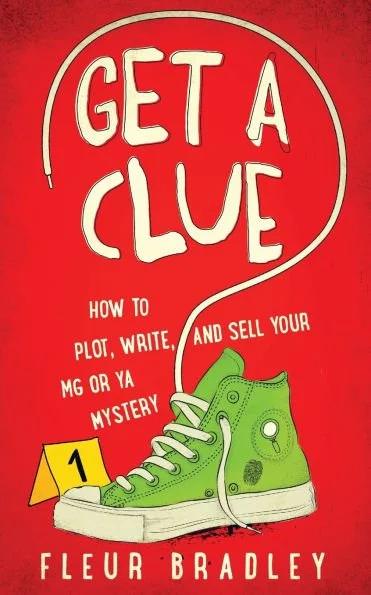
When I heard award-winning mystery author Fleur Bradley was compiling her writing wisdom and process into a compact guide on how to write mysteries for kids, I jumped at the chance to get an advance copy. Plotting a mystery is no small feat! Where do you put the clues? How do you make sure everything is leading to a satisfying conclusion, and not just for the case but for the main character as well?
As a member of the same SCBWI chapter, I’ve gotten the opportunity to hear Fleur teach in person several times, but this book is the next best thing, capturing her wisdom and wry wit in a compelling combination that makes the content easy to understand and implement. It’s simply fun to read, and with the amount of examples and “your turn” applications that cover everything from setting to finding the best times for you to write, mystery writers of all kinds will find lots to underline, highlight, and sticky note.
This concise and practical guidebook gives you everything you need to write a mystery for kids from start to finish. If you’re interested in seeing what sets this book apart, I’ve highlighted some of my favorite parts below (check out the sequences in particular!). But since there’s definitely too much to share, you’ll just have to read the book! And it’s out tomorrow, by the way…
Character Work
Get a Clue gives writers quite a few said clues for how to get started, and I was particularly interested in the sections talking about how to develop the characters at the heart of the story. To start, we look at the protagonist, who needs to be interesting and dynamic, someone whose unique “superpower,” what makes them special, will also make them particularly equipped to solve the mystery. This gets right at the classic stakes question of “What does my character want?” and then asks you as the writer to go even further to make it so hard for them to obtain it that they have no choice but to “dive deep into their soul to get there.”
Fleur makes a strong case for having a fully fleshed out antagonist opposing your protagonist as well as many suspects who will complicate the solution and who can even step in occasionally as mini antagonists who have their own motives for not wanting the mystery solved. One of the best questions in the book is simply “Who benefits from the crime?” I’ll be keeping that one close as I draft my next mystery.

Using Sequences for Plotting
The chapters on using sequences are some of the most concise plotting advice I’ve come across, and as an editor, I’ve read a lot of craft books! The concept of using sequences for plotting originates in film, back when movies were rolled onto reels that held about ten to eleven minutes. Writers needed to break the story at those intervals, and it turns out that these breaks create natural narrative sections.
Instead of trying to look at the book as a whole for drafting or revision, sequences allow you to concentrate on smaller arcs, each one with a distinct purpose that’s driven just as much by characters and their internal conflicts as it is action. Though this method is based in film, sequences are less rigid than other methods derived from movies (I’m looking at you, Save the Cat).
Rather than relying on percentages, charts, or other technical delineations, this kind of plotting steps back for a holistic view. It demonstrates how important it is to give each part of the plot a job and how to craft each of those parts so they build towards a satisfying climax and resolution. Fleur shares, “There has to be a cause and effect to your plot, which is why there is no one-size-fits-all plot outline.”
If you’ve been following our newsletter, you’ll have heard me talking about how valuable sequences have been for my own revisions on a book that I discovered incredibly late is, in fact, a mystery—not just a book with mysterious elements. The concept of sequences has revolutionized how I think about putting a book together, something hasn’t happened since I ran into Christopher Vogler’s The Writer’s Journey in grad school. While I can’t guarantee you’ll have the same experience, I highly recommend giving this approach a try, especially if you’re writing a mystery. Each individual sequence serves a unique role when it comes to building the puzzle and finding the way through, and this approach can help you see what you’ve got, what might be missing, and even where to plant the clues.
“Mysteries for kids are like any other book: you need a solid plot, three-dimensional characters with stakes, and a resolution that makes reading the book fulfilling”
Get a Clue!
This book is a great resource, and as an editor and a writer, I’m so glad to know about it. On both sides of the table, my approach is always to ask questions, and this craft book is filled with compelling questions that will lead to good development of both internal and external plot. If you’re wrestling with a mystery of any kind, I highly recommend checking out Get a Clue.

Looking for someone to walk beside you on your writing journey?
We’re here for you! Whether you’re just getting started or an experienced writer, we make it our mission to support you. Read more on our services page.