Questions to Ask Yourself for the Different Types of Editing
Table of Contents Show
Revision doesn’t have to be the end of the world or even a dirty word! A good revision always brings out the best of your writing, and breaking it down into manageable steps will guarantee you finish your next draft. In this article, we’ll go over the different types of editing, demonstrating how they focus on distinct aspects of your book, and then we’ll give you three questions to focus your revision passes and jumpstart your self-edits. Using the levels of editing and the questions they ask will provide you with direction (and prevent you from getting overwhelmed!).
The three types of editing
Before we get into the questions, we’ll do a quick refresher on the three main levels of editing:
Developmental Editing
Line Editing
Copyediting
Proofreading is officially the last level of editing. However, proofreading—as its name implies—looks at proofs, which are the formatted copies of a book that are reviewed right before printing. Because this kind of edit is production focused rather than story focused, it’s usually shuffled into a different category, and for this article, we’ll keep our attention on the types of edits that will help you out as you revise.
The order we’ll look at these is the same order you’ll want to do with your own revisions: from the most intensive to the least intensive, moving from the book as a whole down to the sentence level.
Two caveats
These questions can be used for manuscripts that aren’t finished yet, but they are most effective with a complete draft.
This overview also won’t go into too much depth on each kind of edit, so you’re looking for more comprehensive descriptions and what they can do, please take a look at the links below:
Questions for developmental edits
Developmental edits concentrate on big-picture feedback, analyzing
character arcs;
audience appeal;
plot development; and
organization.
This edit is designed to develop and enhance your book as a whole. If you’re editing your own book, you can delve into each distinct element on its own, but you can also approach this kind of big-picture look at your work using the questions below.
Have I done what I set out to do with this book?
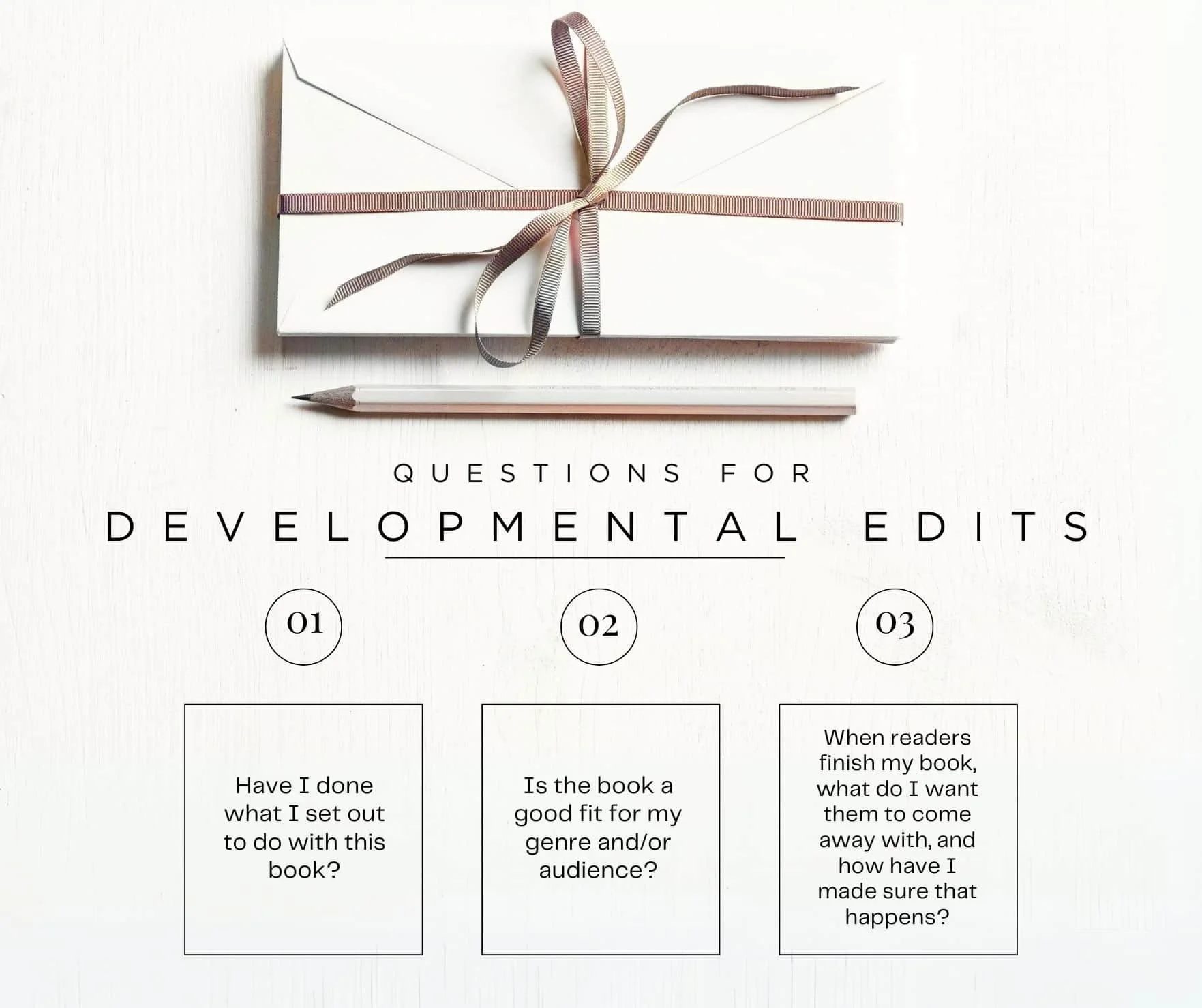
Reflect on the original spark that got you to sit down and write this story. Have you accomplished what you set out to write? For example, if you wanted to write an binge-worthy thriller, do you have elements that lead to quick reading, quicker page turns, and readers staying up too late to finish?
Is the book a good fit for my genre and/or audience?
Still thinking on the big-picture level, consider the plot lines, characters, and tropes that appear in your book. Now think about your ideal reader, the person who will be the most excited to find what you’ve written. What expectations do they have for a book in this genre or style? Are you meeting those expectations?
When readers finish my book, what do I want them to come away with, and how have I made sure that happens?
Do you have a theme or feeling you want readers to take from your book? If so, think about which parts of your book are supporting that theme or feeling. How often is it brought up, shown, talked about, or illustrated in the story? Are there enough story elements to make sure this idea is coming through to the reader?
Questions for line edits
Line editing is the next step down from developmental editing, zooming in from the big picture to the paragraph and sentence level. The priority for line editing is enhancing your writing voice and elevating your writing voice by focusing on
sentence structure and variety;
point of view (POV) shifts; and
character consistency.
Line edits ensure each sentence supports the story, displays your voice, and captures your vision for the book. There can seem to be some overlap with developmental editing here, but remember, line editing is looking at scenes and sentences rather than the book as a whole. These edits should focus on much smaller parts of the book. Below are questions you can ask at the line editing level.
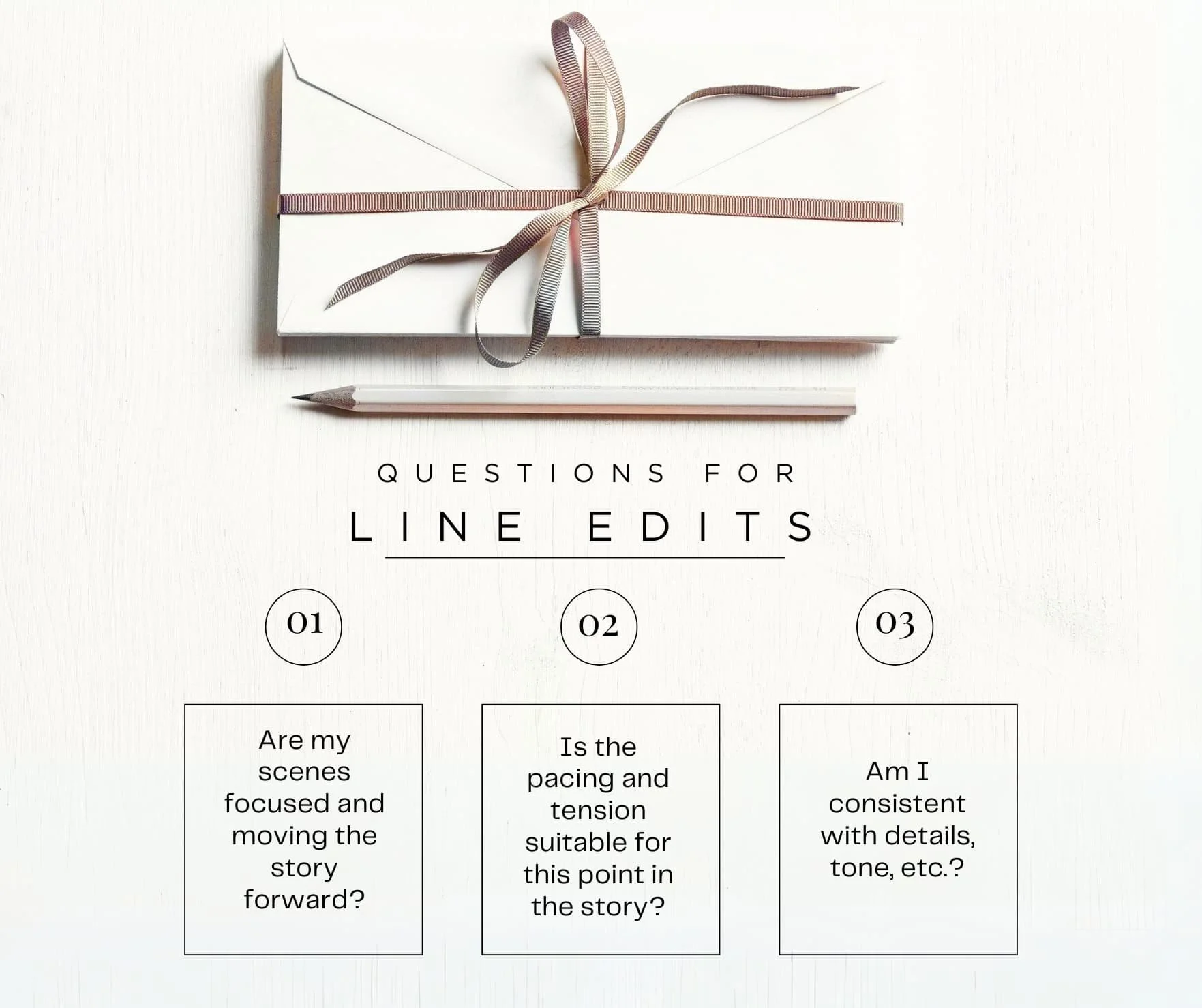
Are my scenes focused and moving the story forward?
Consider scenes on their own—do these scenes reveal more information about a character or plot point, raise the stakes, or add a complication? Ideally, a scene will do more than one. If a scene is repetitive or simply reinforcing something from before, it might need to be trimmed out or revised.
Is the pacing and tension suitable for this point in the story?
Asked another way, Is the pacing and tension too much or not enough in this scene or moment? Pacing should be used wisely, rising and falling with the emotional highs and lows that create compelling writing.
Am I consistent?
Consistency makes your story believable and ensures your reader stays immersed in the words. Character descriptions, verb tense, point of view, tone, and other elements should be consistent from start to finish.
Questions for copyedits
This is the most familiar level of edit for most writers, but we want to challenge you to see copyedits as more than checking for typos and grammar errors. Even at the word level, you can make choices that will elevate your writing and enthrall your readers. Above all, meaning is what a good copyedit strives for—ensuring your reader understands what you’ve written and can engage with it.
Do the words enhance the writing, whether it’s a character’s voice, action, or the worldbuilding?
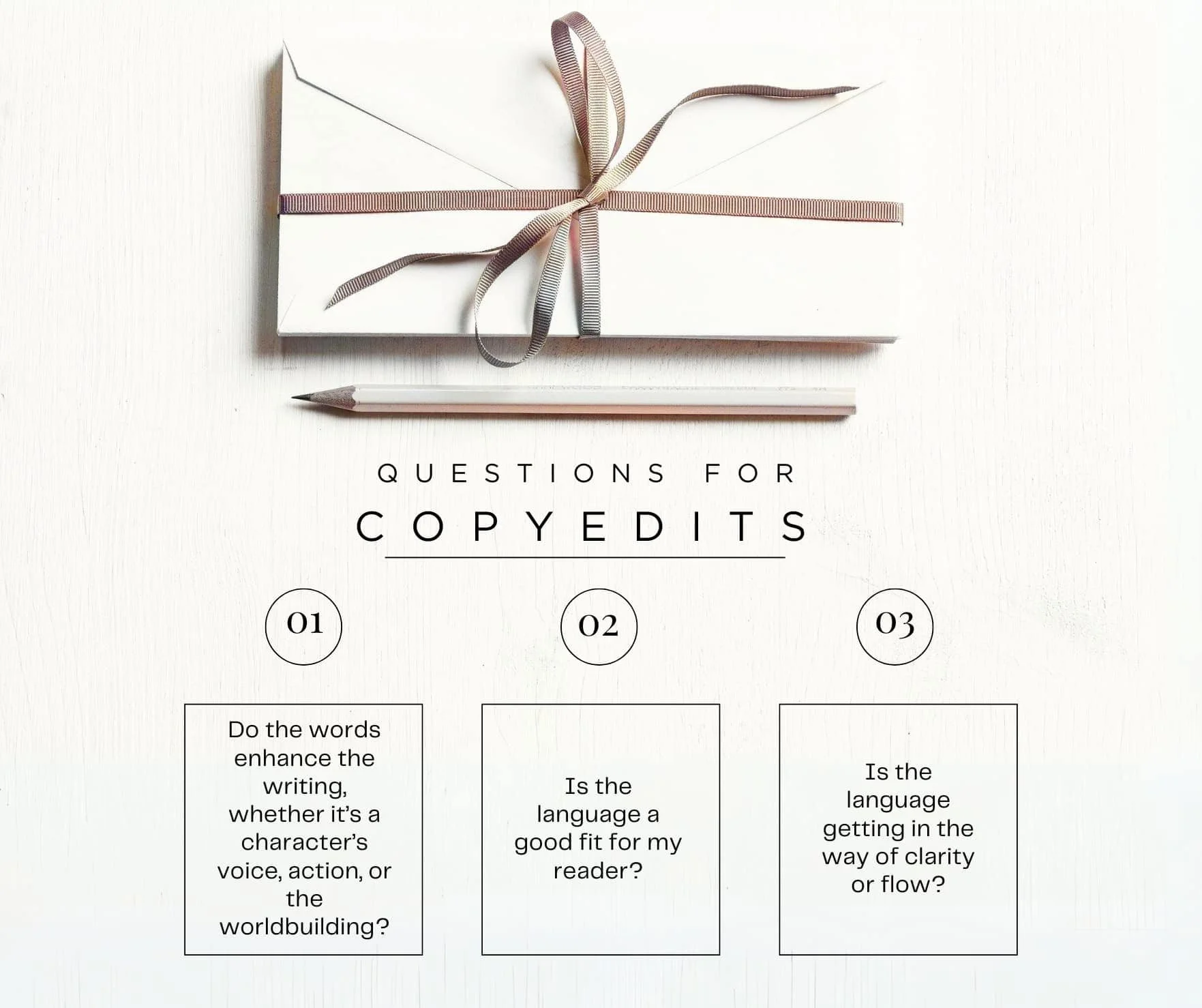
Even small choices can impact the feel of a story, infusing it with energy or voice. However, anachronistic or inconsistent terms can run the risk of pushing readers out of the book.
Is the language a good fit for my reader?
Here, we’re moving from asking if the language enhances the story to asking if the language is a good fit for your audience. Do your readers expect of jargon, complex sentences, or made-up words? Will they enjoy the way the book is written or be distracted or—worse—confused by it?
Is the language getting in the way of clarity or flow?
You’ll notice we’re not asking, “Are there any typos or grammar mistakes?” These are often common culprits when it comes to clarity and flow, but it’s often unhelpful to ask if the grammar is wrong, especially if your grasp of grammar isn’t very strong. This question encourages you to review the words on the page and consider how they sound to someone else. Reading your work out loud (or having someone else read your work aloud) is a great way to discover if meaning is being lost by the way the words appear on the page.
Have more questions?
Editing is a complex process, and there are certainly more questions that can be asked at each level, but we hope these jumpstart your self-editing process, giving you a different perspective on what the different types of editing focus on. As professional editors, these are the the kinds of questions we use to dive deep into your manuscript and help you identify areas that could be strengthened to draw out the richness of your unique writing style.
If you’d like this kind of support for your revision process, feel free to reach out to us through our form or email us at info[at]groundcreweditorial.com.