
Nonexistent Next Drafts: FFXV, Personal Stakes, and Tension
Table of Contents Show
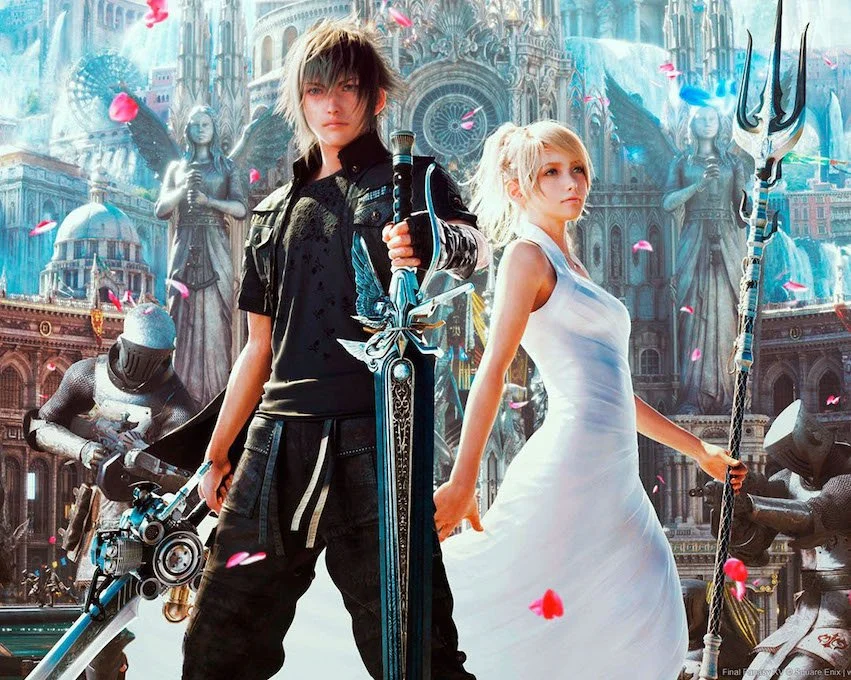
We call these nonexistent next drafts.
It might (or might not) surprise you that, even though we’re daily up to our elbows in story, the two editors at Ground Crew take enormous delight in talking shop about the stories we watch, read, or play in our spare time. There is some serious satisfaction in taking something completely beyond the scope of editing—it’s out there in the world, wrapped with a bow, delivered—and reworking it into a hypothetical “next draft.”
It’s not about the published version being “wrong” or “incomplete,” and the approach that we take for a revision certainly isn’t the only way that a revision could go. It’s about finding out what the story did well and amplifying that so it becomes truer to itself. Most of the time that means bringing already present elements to the forefront and making them shine brighter. Sometimes it means putting in a few missing pieces or teasing out parts that could be doing more work.
With these next drafts, we choose one writing craft element to focus on to demonstrate how that element can be used as a revision tool. Making big-picture changes to your manuscript can be challenging, but we hope that by walking through someone else’s story, you can see how a technique might help you focus or strengthen your own work.
Revision is the space of possibilities, and we hope that these nonexistent “next drafts” inspire you to take another look at your story with the freedom to play and create. You may be surprised there is still so much left to explore.
revision: to see again
The next installment of the Final Fantasy VII remake officially launches this month, perhaps one of the most time-intensive and expensive revisions in the history of storytelling. The remake of the famous game has been many years in the making, and it will be many more years before the story is completely retold in this format (I’ve seen plenty of jokes about how our grandchildren will most likely be the ones to see the conclusion of the story). From a storytelling perspective, FFVII is an interesting case study in revisions—storytelling priorities change over time, techniques develop, and decades-long discussions about motivations and theories grow roots and blossom into entirely new plants. And even as this remake is being made, the story is changing.
Because FFVII is presenting its own version of a new draft, we’re going to take a look at a different Final Fantasy entry for the next installment of our Nonexistent Next Drafts series: Final Fantasy XV. This one’s my personal favorite of the Final Fantasy games, though there’s plenty of room for improvement, as we’ll discuss.
A quick note before we go too much further: video games wrestle a whole host of beasts that novel writers don’t have to tame, not to mention the production process can be a nightmare of changing technology, bureaucracy, time, and budgets. We’ll be looking at the story only for our deep-dive, and for this game in particular, only the story that’s in the main game, not the DLCs, anime miniseries, side games, or follow-on novel. That said, let’s get to the fun stuff.
A brief synopsis
(for those who haven’t played it or need a refresher)
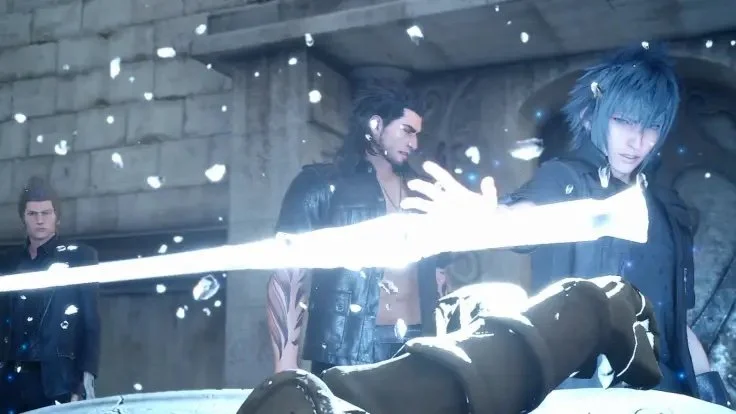
FFXV is the story of Prince Noctis Caelum. His father, the king of Lucis, sends him away to meet his betrothed bride, Lady Lunafreya, just before the Empire launches a surprise attack under the guise of a peace treaty. His three companions and bodyguards—Gladio, Ignis, and Prompto—soon become his only family when they receive the news that Lucis’ long-time enemy has killed Noctis’ father and taken over. Now on the run, Noctis must gain the favor of all six of the Astrals (the higher beings/deities of their world) and recover the King’s Arms (the spirit weapons of past Lucian kings) in order to ascend the throne and defeat the Empire, as well as the much darker forces now at work in their world. The mysterious Ardyn, who originally appears to be trying to help them in their quest, reveals himself to be Noctis’ ancestor, the brother of one of Lucis’ kings. Possessed by the belief he was the rightful heir to the throne, Ardyn is determined to destroy Noctis and the crystal that is the source of the country’s magic and the representation of the line of kings.
Personal Stakes
In our previous nonexistent next draft for Jedi: Fallen Order, we used theme as a developmental editing tool to see how the story could be deepened.
I’m going to approach this revision by looking at how a character’s personal stakes can amplify the tension of the climax and create a more satisfying ending.
Looking at Personal Stakes
Before we get into the climax, it’s important that we’re on the same pages about stakes. Stakes are something writers must have a firm grip on if their story is to feel cohesive. But what are stakes? I like to boil stakes down to three essential questions:
1. What does this character want?
2. What’s keeping them from getting it?
3. What will happen if they don’t get it?
These questions can be answered on an external level (for the plot) and an internal level (for the character). For FFXV, these questions might be answered like this for the personal stakes:
1. Noctis wants to be his own man, to step into his own identity. He does not want to be king.
2. This is difficult because he’s a prince who’s forced to take on the obligations of being king. His identity and role have largely been predetermined. He’s also his own worst enemy, avoiding his responsibilities and not making decisions for himself.
3. If he doesn’t step into his own identity, his connection with his friends will be broken and the sacrifices made on his behalf will be wasted. On a much larger scale, if he doesn’t accept his identity as king, the land will be never be free of the darkness again.
To give you a better picture of the personal side of the story, I’ll touch briefly on the supporting cast, since interactions with them are where most of Noctis’ character development takes place.

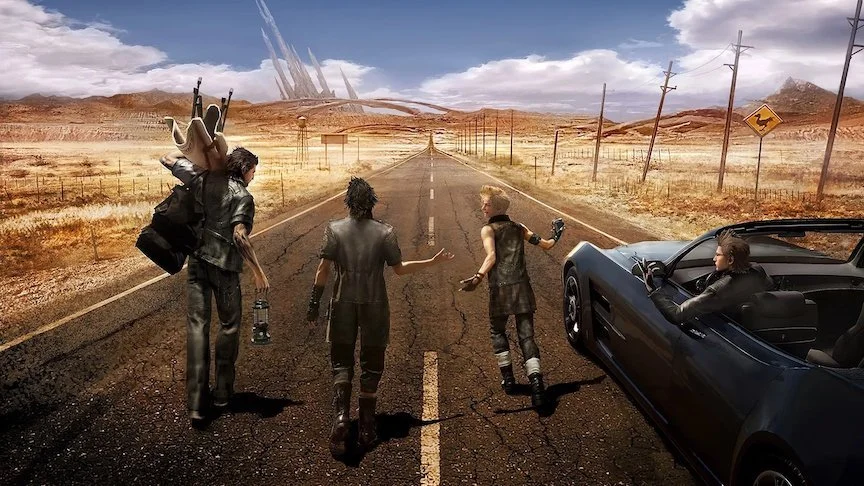
Gladiolus Amicitia is Noctis’ shield, the brawn and tough guy of the group. Ignis Scientia serves as the brains of the outfit as tactician, driver, and gourmet chef. I had a harder time figuring out why Prompto Argentum is included, functionally speaking, on the quest, but he is their pistol-wielding photographer, resident chocobo-lover (well, they all love chocobos), and the one most likely to do something crazy. All three of them have been Noctis’ bodyguards and friends since they were quite young. Noctis, in the company of these guys, is developed as a quite likeable prince who, though he often sleeps late and hates vegetables, works through the difficult task of stepping up to take his father’s crown and save his people.
Noctis’ reluctance towards his role as king is obvious, even in the gameplay. In between plot missions, Noctis is free to fish to his heart’s content, feed stray cats, and hunt down car wax for the Regalia, their sleek ride, without any sense that they’re dawdling or drawing close to a deadline even though they originally left to get Noctis to his own wedding. He is constantly being protected and saved by others. When he is nearly killed by the Astral Leviathan, Luna gathers him into her arms and summons Titan, who rises from the ocean floor to protect the fallen prince. In interactions, Noctis doesn’t often stand up for himself, forcing the guys to do it for him. Like good brothers, his friends try to encourage him the whole time to take on his responsibility, to become his own person, but he’s not there yet.
After the disaster with Leviathan, however, it’s clear that Noctis has to decide who he is going to be. Protecting Noctis, Luna is killed and Ignis is blinded. This strikes directly at Noctis’ stakes—he doesn’t want to be king. He doesn’t want people he loves to sacrifice for him like this. But he can’t keep running from this choice. He must either surrender or step up.
Moving into the Climax
Now keep those personal stakes in mind as we take a look at the climax of the story.
The Canon Version
The climax for FFXV begins with a confrontation with Ardyn in Insomnia, the capital city now overrun with demons. Ardyn lures Noctis to the crystal that gives him his powers and can help them defeat the monsters outside. Instead of granting the prince power, the crystal absorbs him, however. Before Noctis disappears, Ardyn explains that he wished Noctis to gain the power of the crystal and become king so that when he was defeated, Ardyn would be destroying not only the royal line but the crystal as well. Inside the crystal, Noctis learns that while it is still true that he will be king, his death is required to save the land.
Abruptly after this revelation, however, the story jumps ahead ten years to when Noctis reappears on a remote island. With shaggy hair and a sparse beard, he now appears much older. From his looks, demeanor, and even altered movement, everything seems to be saying that this is a totally new character—which is not what a player wants after nearly reaching the end of the story.
He learns that his friends have gone their separate ways, and their reunion is painfully low key and understated. The climax itself is fairly quick. Once the guys don their old uniforms and Noctis puts on the kingly raiment, a sharp business suit with dramatic cape, they seek out Ardyn for the final confrontation. Noctis, for all intents and purposes, has become a version of his father in looks, manner, and gravitas. But as is made clear, Noctis was not aware that ten years passed, so he should be exactly as he was when his friends saw him last, changed only in his understanding of what he has to do and his determination to do it. Ignis, Gladio, and Prompto are removed from the fight with Ardyn before it begins, leaving Noctis again on his own. After that fight, the guys join him outside on the palace steps, the same place their journey began. There is a brief moment where they say goodbye to each other, but the way this appears is more like “Well, it’s been real, guys” than a serious farewell and conclusion to their brotherhood. They stay behind to fight the demons approaching the palace while Noctis goes inside, alone again, to fully ascend the throne and ultimately defeat the darkness. This is a scene with undeniable impact because he is essentially run through by each of the former kings as they give him their power, the last being his father, who hesitates. Nearly killed by this alone, Noctis defeats Ardyn again in the hereafter with all of his allies at his back: his father, Luna, and the guys. After this, he shatters into pieces of light.
Strengthening the Climax with Personal Stakes
Putting aside the fact that a ten-year time skip right before the climax inevitably makes the tension plummet (a terrible idea, please don’t do this), let’s take a look at how the climax could be improved by more intentionally incorporating the main character’s personal stakes.
The climax is the perfect place to bring the external plot and the internal plot together and let the sparks explode. The external plot here is clear—Noctis has to use all of the powers of the Lucis kings to defeat Ardyn and then reverse the darkness that’s spread across the land. The internal plot is far murkier. Noctis becomes the king, but why doesn’t the ending feel that satisfying? The problem is the fact that his personal stakes don’t come into play along with the external plot. He didn’t want to become the king, and he definitely didn’t want to be like his father. He wanted to be his own person. So having him take on the appearance of his father and dutifully step up to the plate—alone—really doesn’t fulfill his arc.
So how might this problem be fixed?
We go back to the personal stakes. Noctis wants to decide his own path. So here at the ending, it should be clear—who is this character? What path will he choose? The story that we’ve been seeing is that Noctis belongs to a band of brothers. They’ve grown up together, faced hardships together, and fought side by side.
From a revision standpoint, this means that Noctis should not be taking on the climax alone.
Change #1—A smaller skip
First, we have to fix the time skip problem. In the original, when Noctis returns, no one is looking for him, the relationship between the guys has faded, and they are almost strangers to each other. This undermines Noctis’ personal stakes; choosing who he’s going to be when he is no longer known means it doesn’t really matter. I’d recommend making him go missing for several weeks at most. This would allow his absence to have a profound impact on his friends without losing the tension of the imminent end of the world. I would also have them be actively looking for him, which would make their reunion much more exciting and emotional. Their band of brothers has been reunited again, and they’re feeling like they have a chance to win the day. But there’s a good (but painful) realization here, as Noctis is returned to them with a new understanding. He knows now that if they’re going to win, he’ll have to sacrifice himself, essentially giving up his life with them. There should be some tension here about what he’ll ultimately do. Can he give up the life he chose to fulfill the duty he didn’t want?
Change #2—No fighting alone
There are two important fights in the climax, and to pull in Noctis’ personal stakes, it’s vital that he doesn’t face these by himself. He is only able to face the climax because of his friends—because who he is as a person has so much to do with their influence and presence in his life—so they should be there. He is choosing to be king, but he has not become someone else. I would recommend letting the guys be a part of the first fight with Ardyn, realizing that they’re hopelessly outmatched and getting into desperate straits. At that point, they’d still be trying to protect Noctis, but this is where he steps up and fights Ardyn off with an Astral summon or the Kingly Arms—a way to signify his rise as king, the one who protects the people, and a reversal of their roles. He now understands why he has been protected and why he is so important.
Before the second fight with Ardyn that takes place on more of a spiritual dimension, the guys should be there to witness Noctis’ ascension to the throne and watch him go through the painful process of acquiring the power of the crystal and the ancient kings. They have devoted their whole lives to keeping him alive, and the fulfillment of their duty is having to watch him give up his life. This is heart-wrenching, of course (in a good, if miserable, way), but it parallels so nicely with his development and acceptance of his destiny. He is choosing this path for himself and not hesitating, not looking back.
In the crisis of the story (an earlier section when Noctis is alone in a kind of nightmarish level), Noctis decides to put on his father’s ring, symbolically taking on the kingship. This is perfect for the crisis—he’s forced to see himself outside of the context of his friends, and being apart from them is the hardest thing he’s had to face. But on a story craft level, his personal stakes can only be fulfilled in the climax by having witnesses to this decision who recognize what he’s chosen. This turns his choice to ascend the throne (and in doing so, give up his life) from being inevitable fate or obligation into a sacrifice made for love—and that tells us so much more about who Noctis is. He’s no longer a boyish, immature prince. He’s the king.
Knowing what kind of king Noctis has decided he is going to be also makes this final fight with the antagonist stronger because he will have already established himself as the rightful king by this action. Ardyn, whose self-centered focus on becoming king has caused countless deaths and brought disaster to the world, is the counterpoint to Noctis’ self-sacrifice. Both of them have the same powers, so the fight illustrates two very different answers to the question “Who will you be?”
Conclusion
A character’s personal stakes are an essential component in any story, and the most gripping climaxes and satisfying conclusions are the ones that combine both the internal and external conflicts. I hope this example illustrates how you can use deep knowledge of what a character wants to bring more tension to a climax, as well as strengthen a scene and fulfill a character arc. I hope you can also see that this doesn’t mean that the character always gets what they want in the end—at least not in the way they thought. Noctis does choose his own identity by the end, and part of that choice involved accepting what he could not change. But rather than resignation or defeat, he rises to the challenge because of who he has become as a result of his relationships and experiences.
It can be easy to lose track of a character’s personal stakes during a climax because there are often many threads coming together that need to be deftly handled, but taking them into consideration can help you pinpoint what might not be working in your climax and heighten tension and impact.
And so, writers,
I hope you’ve enjoyed a wander through this story, taking a look at how personal stakes can be used to add depth to a scene and support a satisfying conclusion. Consider your own work.
Do you know what your main character’s personal stakes are?
Have you spent time thinking about that important third question—what will happen if your character doesn’t get what they want?
Do your character’s personal stakes connect to the external plot in the climax? In other words, does what’s happening in the climax support, complicate, or contradict the inner desire of the main character in some way?
Think about how you might use personal stakes to transform your work, to see it again.

Have a story of your own that you’d like to do a deep-dive on?
A developmental edit might be just the thing your book needs. You can read about how we can help you make your book truer to itself through powerful revision on our services page.
Images from the game are property of Square Enix.
