
Poetic Devices: The Importance of Rhythm in Writing
Table of Contents Show

The other spices in the cabinet: more than rhyme
As poetic devices go, the one that we are most familiar with as writers is rhyme. We know it when we hear it, when we see it. For picture book writers, it is often a go-to device. For novel writers like me, we can occasionally sprinkle in rhyme for a nice turn of phrase. However, it is just one of many kinds of poetic devices, and today we’ll be looking at rhythm in writing.
It can be helpful to think of these devices like spices in your cabinet. If you know their names and what they taste like, you're far more likely to use them and enjoy what they add to a dish. They deepen flavor and add complexity, not to mention personality. And in the same way, you do not, EVER, use all of the spices while you're baking—goodness no. But a little bit of this, and a little bit of that? Now you've got something special.
Poetic devices are not limited to poetry
They are literary elements that elevate prose to a level that is pleasing to the ear (particularly important for picture books and other work that is intended to be read aloud) and satisfying to the mind, just like spices elevate a dish to something more than just flour and sugar, or cornstarch and broth. Some of them are more exotic—you might think of these like saffron or fenugreek. Some are more common and well-loved, like cinnamon or thyme. Others are overlooked but awesome, like cardamom. And still others are just enough to make you see something in a new way, like star anise—that's the taste we call licorice.
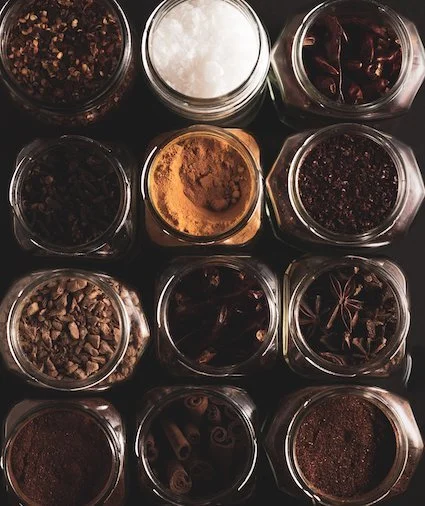
I also chose this cooking metaphor to show you how poetic devices are not just ways to liven up our writing, but also to show they can function as structure. Continuing our metaphor, you could think of this as the difference between putting lemon zest in a muffin and a lemon bar. In the muffin, it is a simply added in to what's already there. This would be the use of poetic devices throughout a manuscript to liven the prose. These are sometimes so subtle you don't even notice them. However, in a lemon bar, that same taste is now the core and defines the whole dessert. In a manuscript, this would look like a repeated pattern, a word or sound that links the story together. We'll talk more about what that can look like a little later on—stay tuned for the rest of this series!
Devices as spices
I also chose this metaphor because I'd like you to think of these devices as spices (see what I did there) because they are things to play with and enjoy. Try them out and see what you think. And even better, you don't have to eat what doesn't work out. Just like you can combine different flavors to see what happens, you can use these in a wide variety of ways, and they can inspire story ideas in themselves. I'll also be talking about how to use some of these for brainstorming exercises.
Rhythm in writing
Most of you, whether you are picture book authors or novelists, already have a pretty good sense of rhythm, whether or not you are consciously aware of it while you're writing. We know what "sounds good." And often, what sounds good is a matter of rhythm. Rhythm is created by sentence length and type, as well as the pattern of syllables used.
Iamb: unstressed + stressed
We're going to go back—briefly, I promise—to English class. You might remember the term "meter" in relation to poetry. Meter is the rhythm of a poem as it's expressed through the number and length of the feet in each line. A foot is one unit of stressed and unstressed syllables. If the stressed syllable is followed by an unstressed one, then it is called a "trochee." If the unstressed syllable comes first, it’s called an "iamb." So iambic pentameter simply means five units of unstressed/stressed syllables in a line. Iambic feet are the most commonly used for English speakers, and sometimes we slip into it without thinking.
Take a look at this line from Robert Frost’s famous poem “Stopping By Woods on a Snowy Evening.”

And this line from William Shakespeare’s Romeo and Juliet.
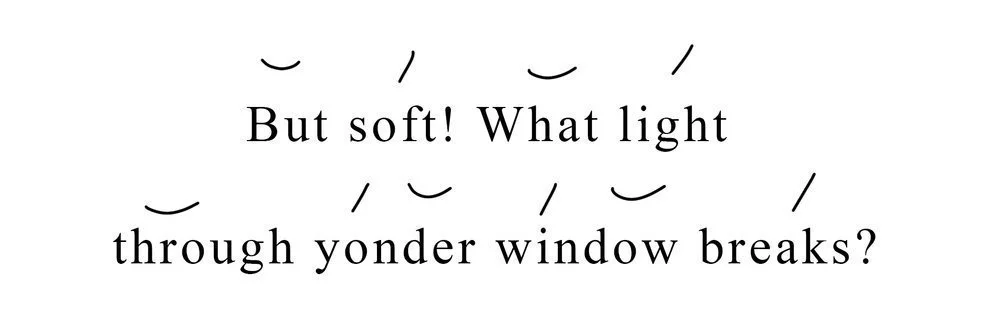
When sentences use iambic meter, we can read them in a "sing-songy" way. But it is natural and pleasing to the ear. It’s often used to recreate the sound of heartbeat.
Trochee: stressed + unstressed
Trochees sound more haunting and “off.” Since we already have a Shakespearean example, I'll show you what this looks like. The Witches in Macbeth speak in trochaic tetrameter, meaning four feet of trochees. The most famous part:
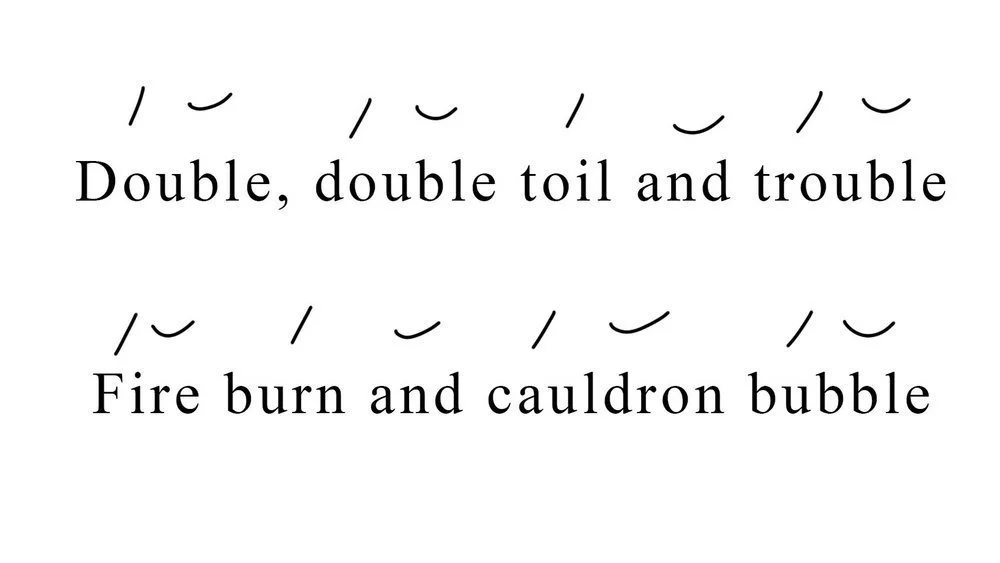
Because they are the only characters who speak in this pattern, they sound eerie and strange.
Other kinds of rhythm
A spondee is two stressed syllables, like “get out,” “stop that,” or words like “sunset” or “handshake.”
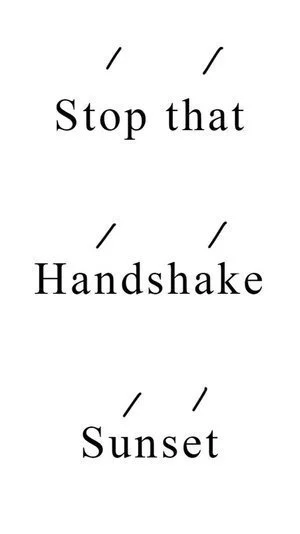
There are others, of course, like anapestic, when you have two unstressed syllables followed by a stressed one, as in “in the blink of an eye.” But these are the most common that you'll find.
Why is paying attention to meter important in my writing?
In short, variety in your meter makes your writing stronger and more engaging.
Iambs, trochees, and spondees...while you don't necessarily have to remember these names, stressed and unstressed patterns are the underlying rhythm in every sentence that you write. The music. If something sounds a little off or it doesn't quite sing, it might be a matter of fixing the meter. What is stressed and unstressed in your choice of words is an important poetic element to keep in mind, one that is arguably the most important of all.
Modern poetry does not use strict meter or rely on tight conventions for form, such as certain number of “feet” per line, so you won’t often find many manuscripts that fall neatly into these patterns. But you will find that meter is still put to great use.
For books, I also extend this to sentence structure. Long sentences have different rhythms than short sentences, as do adverb phrases, participial phrases, interjections, and other add-ons to sentences. Use a variety of them to make reading a delight.
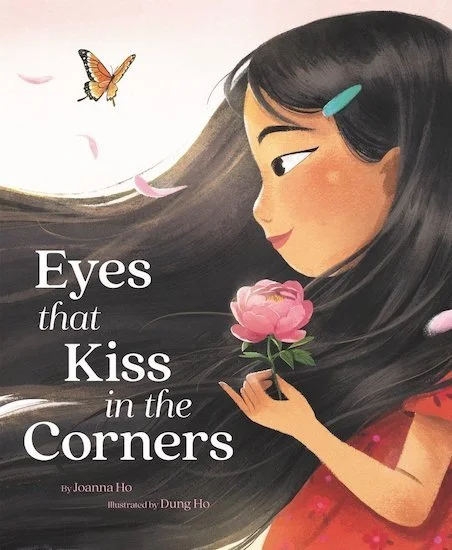
An Example of Poetic Meter from Joanna Ho’s Eyes that Kiss in the Corners
As an example of variation in sentences with varying meter, we'll take a look at Joanna Ho’s picture book (gorgeous illustrations by Dung Ho). It has a lot of great examples of what we’re going to be covering in this series about poetic devices, so you can see what they can look like when applied to a book as a whole.
These lines are taken from the first two pages of the book with the stress marks added:
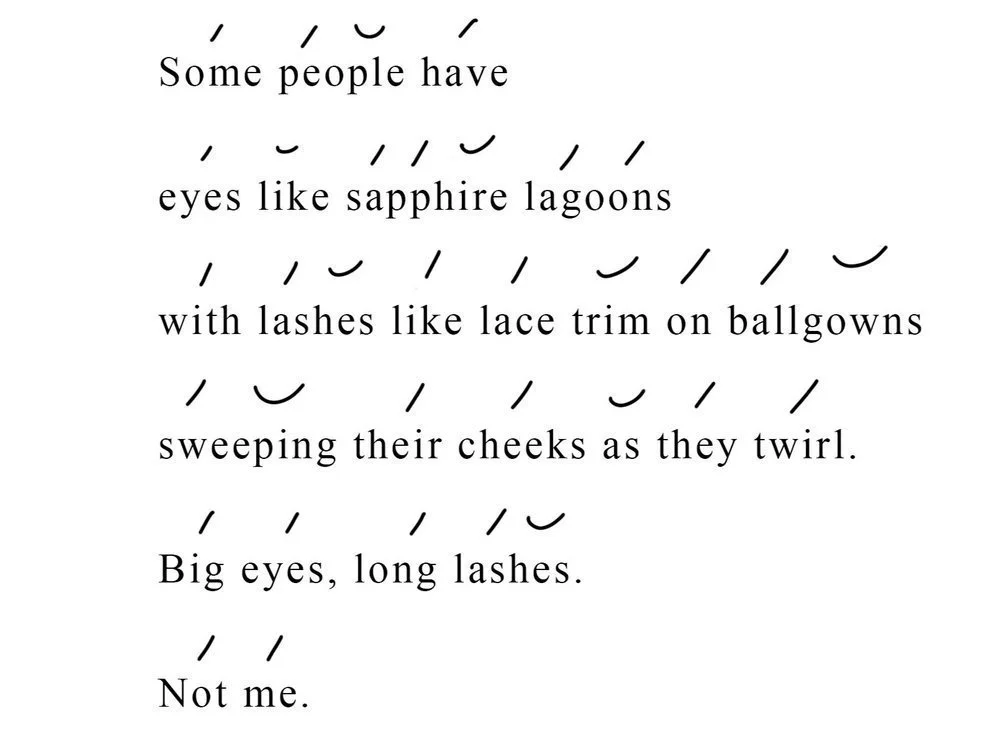
See how long this first sentence is? There’s an extra phrase starting with the word "with" to further describe the eyes, and this same sentence has a participial phrase on the end, starting with "sweeping." This is a long, sweeping sentence itself. Then, there's a transition. A fragment—“big eyes, long lashes.” And then, all by itself on the next page, just this: “Not me.”
The meter indicates a change. By the rhythm, the reader is interrupted and that makes them pay attention. As you might have guessed, it doesn’t fall into a neat iambic pentameter or other meter. However, there is a similar pattern. See how often an unstressed syllable is followed by two stressed ones? Particularly that line starting with “sweeping.” Does this pattern remind you of anything? Perhaps a waltz?
Then look. Almost all accents. A spondee with “big eyes,” and then another spondee with “not me.” The waltzing rhythm is broken for the contrast.
Look for places in your own writing where you can vary the rhythm to craft sentences that are a delight to the ear (if read aloud) or to the mind, as well as to engage readers!
Want to read more about poetic devices? Stay tuned for part two of this series!
Thanks to Pratiksha Mohanty, Alice Pasqual, and Christina Rumpf for the beautiful images used in this post, used via Unsplash.
