7 Habits of Effective Writers | Habit 1: Be Proactive
Table of Contents Show
A few years ago, I was transformed.
Previously, I was strictly a fiction-only reader in my free time, but then, after being bitten by a radioactive paperclip (or something similar), I became someone who willingly picked up business and leadership books. Turns out this was in line with Habit 1: Be Proactive, and these definitely came in handy later on when I started editing professionally, but I was surprised even then at how much practical wisdom can be gained from nonfiction seemingly restricted to entrepreneurs and other kinds of business go-getters. One book that’s substantially changed me is Stephen Covey’s 7 Habits of Highly Effective People.
While Mr. Covey’s work has definitely had a profound impact on businesses and corporations, there are tremendous widespread applications for the seven habits. In fact, the first time I read it, I was already thinking, This is perfect for authors.
Since then, I’ve gone through to condense and adapt the seven habits for writers who want to become effective, and we’ll be tackling these habits one week at a time to discuss the 7 Habits of Highly Effective Writers.

What is an effective writer?
An effective writer is one who knows why they do what they do and understands how their process will get them there. It’s a short sentence, but it contains two very big ideas, and it’s the career work of an author to keep refining the ways you approach the why and the how.
Your editors here at Ground Crew Editorial are here to help you take off. A big part of a successful takeoff is ensuring you can keep flying, or keep writing. How you keep writing is an aspect we call creative longevity. It’s easy to write when you’ve got a fresh new idea, but we all know writing isn’t always like that. Almost every aspect of writing takes a long time, and if you intend to create and keep creating, creative longevity is vital.
“Passion for your work is a little bit of discovery, followed by a lot of development, and then a lifetime of deepening.”
—Angela Duckworth (Grit: The Power of Passion and Perseverance).
An effective writer needs habits
To sustain yourself for the long haul, you need structures, attitudes, and behaviors that enable you to go deeper, to grow and do your best work consistently. In short, you need habits. There are too many rich insights in the original 7 Habits book to cover in a simple blog post, but it’s my intent to give you the condensed writerly edition. We’ll be talking about
practical application (things you can implement right now) and
philosophy (things that take more ruminating but are worth it in the long run).
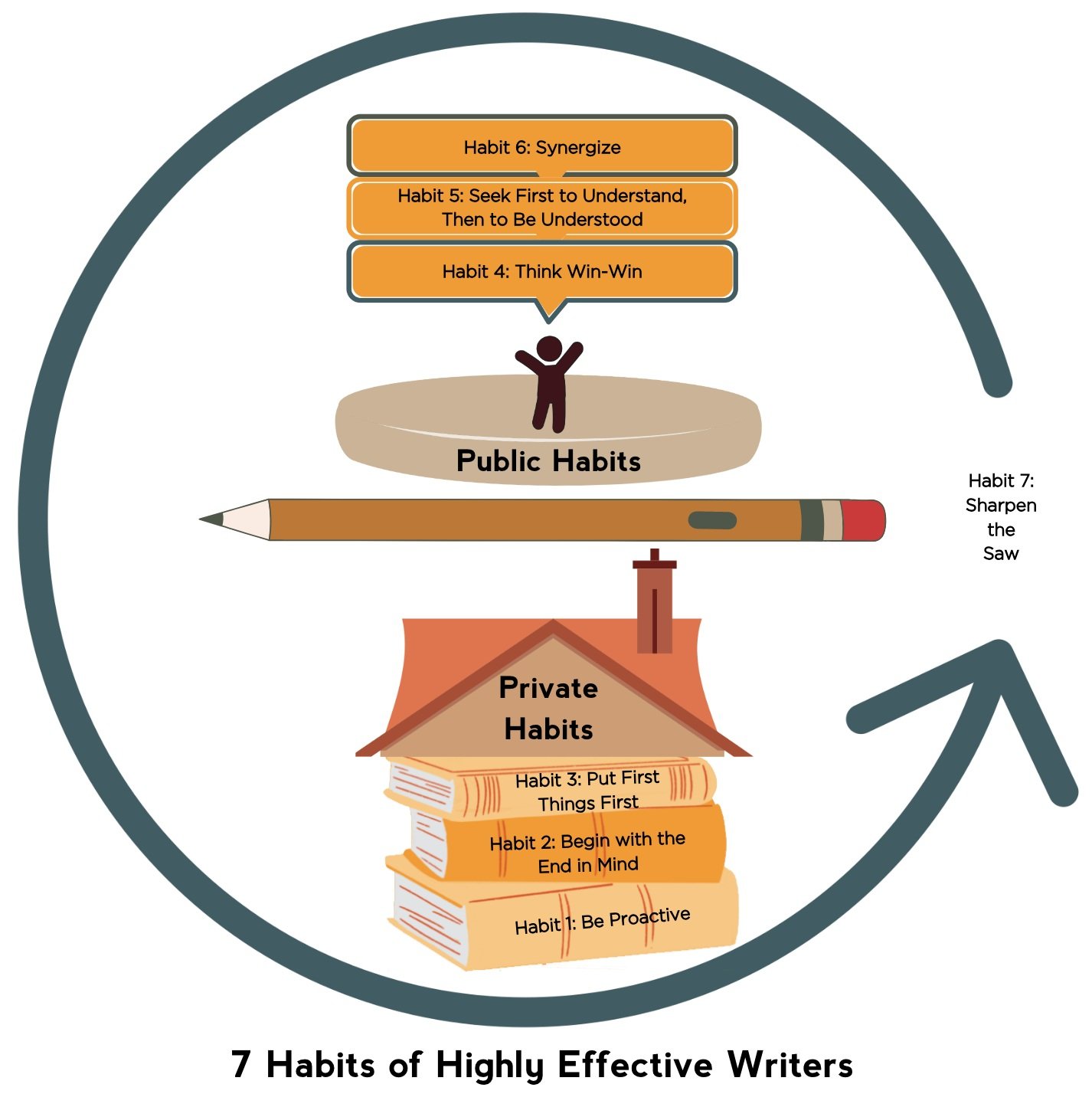
The 7 habits of highly effective writers
If you’ve read The 7 Habits of Highly Effective People, you’ll notice that the 7 Habits of Highly Effective Writers are the same as in the original. However, how we’ll apply and use these habits is slightly different.
For this application of the seven habits, I’ve made my own version of the diagram that represents how they relate to each other. In Mr. Covey’s book, the seven habits are divided into two categories: private victory and public victory. The author does a lot to unpack that term “victory,” so for simplicity, we’ll keep it simple and call these private and public habits. As you can see, each habit supports the next, the private habits supporting the public habits. So naturally, we’ll start at the bottom of the diagram and work our way up.
Habit 1: Be Proactive
Habit 1 is all about your attitude around what you can do. This encompasses quite a lot for writers:
your attitude regarding your talent for moving others with your words
your ability to develop a new idea
your ability to be published
your capacity to handle the demands of self-promotion
your skill to write another book and another
This is a short list, but you’re probably already feeling a little bit of uncertainty thinking through it. Most writers struggle with doubt, either on the page, in the marketplace, or both. Putting your writing out anywhere, even in a notebook, is an activity that makes you vulnerable. As we all well know, the industry as a whole really isn’t designed for writers, people who already carry around a lot of doubt—there’s whole buildings of people ready to reject you according to predetermined quotas and budgets. If that wasn’t bad enough, there’s a whole internet of readers ready to reject your characters and ideas with one star reviews. Knowing this can leave you in mentally dire straits. But you don’t have to stay there.
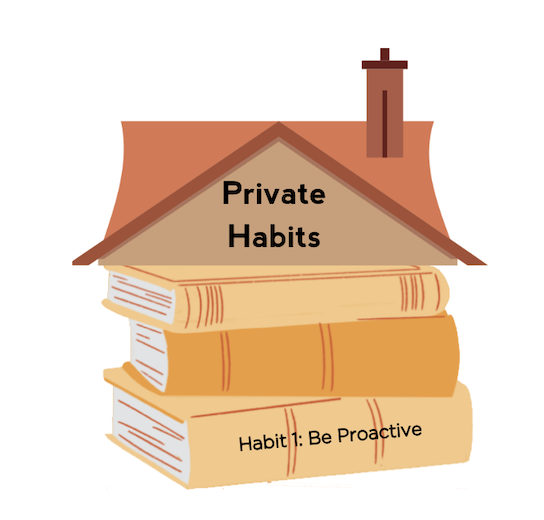
You can be proactive or reactive
Contrary to what you might believe, you have the initiative and the responsibility to make things happen. You always have a response ability—the ability to respond. Whenever you encounter difficult circumstances or realities, you have two options: you can be reactive or proactive. Most authors likely default to a reactive response, often without realizing it. Listen to the language that’s used all the time:
“The industry is so slow.”
“No one wants to read a book like mine.”
“I can’t get an agent.”
“There’s so much I have to learn and I don’t know where to start.”
“If only things would change.”
All these boil down to how you see yourself and your work. Who are you anyway? What can you do? It turns out, you can do quite a lot.
An effective writer is proactive
You can become proactive, focusing on what’s inside your area of influence, what you can control, rather than focusing on what you can’t. Knowledge, skill, and desire are always in your hands. Put another way, the knowledge of what goes into a good book, the skill to create a good book, and the desire to share a good book with a reader are all things you have, or if you don’t have them yet, you can work on that.
Being proactive doesn’t mean you’re not affected by storms, doubt, and worry. You listen to your feelings because that’s what makes you good at what you do, but being proactive means you aren’t driven by those feelings. When you become active rather than passive, you choose to try, and that’s how you grow. You can choose to get out from under the rainclouds of bad news and discouragement. You can carry your own weather. That sounds good, doesn’t it?
How do you become proactive as a writer?
Habit 1 is essential to all the others because everything else stems from the first decision to act. Instead of responding and reacting to external factors, you build a strong internal foundation that ensures you’re able to stand strong no matter what the industry, reviews, or life throw at you. Being proactive as a writer boils down to two basic directives:
Make small commitments to yourself and keep them.
Listen to how you talk about yourself and change the focus.
Make and keep small commitments to yourself
These commitments should be meaningful to you—whether it’s committing to writing every day, submitting pages for feedback, or even something as simple as introducing yourself as an author or illustrator when someone asks what you do. You can also take things that seem large and break them into smaller pieces that are within your control. You can write one sentence. You can study one mentor text. You can read one newsletter or attend one talk. You can ask one question.
Listen and change the focus
Your words have power. As an author, you know this in a profound way, but the words you use with yourself are as powerful as the ones you write to influence others. It’s terribly easy to slip into the adages and maxims of writer groups everywhere, especially when you’ve heard them over and over at conferences and on social media. But remember—you have a choice.
Instead of saying, “The industry is so slow,” you say,
I can keep working on my craft and other projects.
“No one wants to read a book like mine,” but you say,
I will find readers who love what I write.
“I can’t...”
I choose.
“If only…”
I will.
Habit 1 is the foundation for all effective writing habits
As we said above, everything stems from the first decision to act. But now that you’ve decided to act, how do you know what to do? That’s where Habit 2 comes in: Begin with the end in mind. This is part of an ongoing series, and this blog will be updated with links when the next part is available.
Practice being proactive with an editor
Reaching out to work with an editor is on the biggest ways to practice being proactive. At Ground Crew Editorial, we recognize what a big step it is to hand your book over to a professional. We also recognize that it’s a commitment you’re making to yourself. We strive to honor that commitment by doing all we can to help you move from “I can’t” to “I will.”
If you’re just getting started and having trouble getting that first draft on the page, perhaps book coaching might be a good fit. If you’re ready to jump into revisions, a manuscript assessment or developmental edit can be a great way to figure out what’s working and what isn’t in your current draft. But wherever you find yourself in your writing journey, we’re here for you. Let us know how we can help!
Thanks to Pablo García Saldaña on Unsplash for the photo in this post!