7 Habits of Effective Writers | #3: Put First Things First
Table of Contents Show
Today, we’ll be talking about the third habit of the 7 Habits of Highly Effective Writers: Put First Things First. Since this is being written at the beginning of a fresh new year full of possibilities, it’s a fitting topic. This is a good place to start, but if you need more context for this series, feel free to nip back to Habit 1: Be Proactive to catch up on the other habits.
The ideas contained in the 7 Habits of Highly Effective Writers can be used by writers of all kinds, and each one supports the other. We’re big into building habits around here as they are a surefire way to ensure you can create today, tomorrow, and for a long time to come.

What is an effective writer?
Our working definition of an effective writer is as follows: An effective writer is one who knows why they do what they do and understands how their process will get them there. Process, almost by definition, includes habits. Establishing productive routines to cultivate and sustain your creative energy will support you through any creative endeavor you sit down to accomplish.
"A small daily task, if it be really daily, will beat the labours of a spasmodic Hercules."—Anthony Trollope
An effective writer is proactive and begins with the end in mind
Habit 3 is built on the foundation of the other two private habits, or habits that are practiced and perfected in yourself as an individual:
Habit 1: Be Proactive
Habit 2: Begin with the End in Mind
Essentially, these two habits boil down to 1) the decision to act and 2) making a plan for where you want to go. While it might seem to be out of order, Habit 3 is dependent on these first two. If you haven’t solidified the first two habits, be sure to revisit them before moving on to Habit 3.

Put first things first
This habit teaches you to recognize priorities and organize yourself around them. Effective self-management should be a priority for writers. You are surrounded by a thousand potential ways to spend your efforts and time. Putting the demands of daily life aside, there’s the endless research, the endless revisions…the list goes on and on. However, if you’ve put in the work of defining your values and where you’d like to go (Habits 1 and 2), you already have the foundation for figuring out which things you need to put first.
Learn what your biggest yes is
The key to this habit is learning to say no. This can be difficult, but it’s absolutely necessary. Saying no allows you to say yes to something else, a bigger “yes.” As Stephen Covey states in his book The 7 Habits of Highly Effective People, “You have to decide what your highest priorities are and have the courage—pleasantly, smilingly, nonapologetically, to say ‘no’ to other things. And the way you do that is by having a bigger ‘yes’ burning inside.” Put another way, that bigger “yes” should be burning inside you so brightly that it becomes the courage to say “no.”
The Time Management Matrix
To identify your priorities, you first need to figure out what matters most. Rather than relying on feelings or emotions to determine this, you can use a more objective tool to evaluate how you spend our time. In the 7 Habits book, you’ll find the Time Management Matrix. It’s divided into four quadrants with the axes of urgent/not urgent across the top and important/not important down the side. Importance, for our purposes, is related to results in relation to the effort put in—the return on investment (see the lower graph for another way to think about this). We’ll look at each quadrant, moving counterclockwise.

Quadrant I: Tasks that are urgent and important
pressing problems
deadline-driven projects
crises
Quadrant III: Tasks that are urgent but not important
interruptions
some meetings, email
popular activities
These can sometimes feel like Quadrant I tasks, but they aren’t.
Quadrant IV: Tasks that aren’t important and not urgent
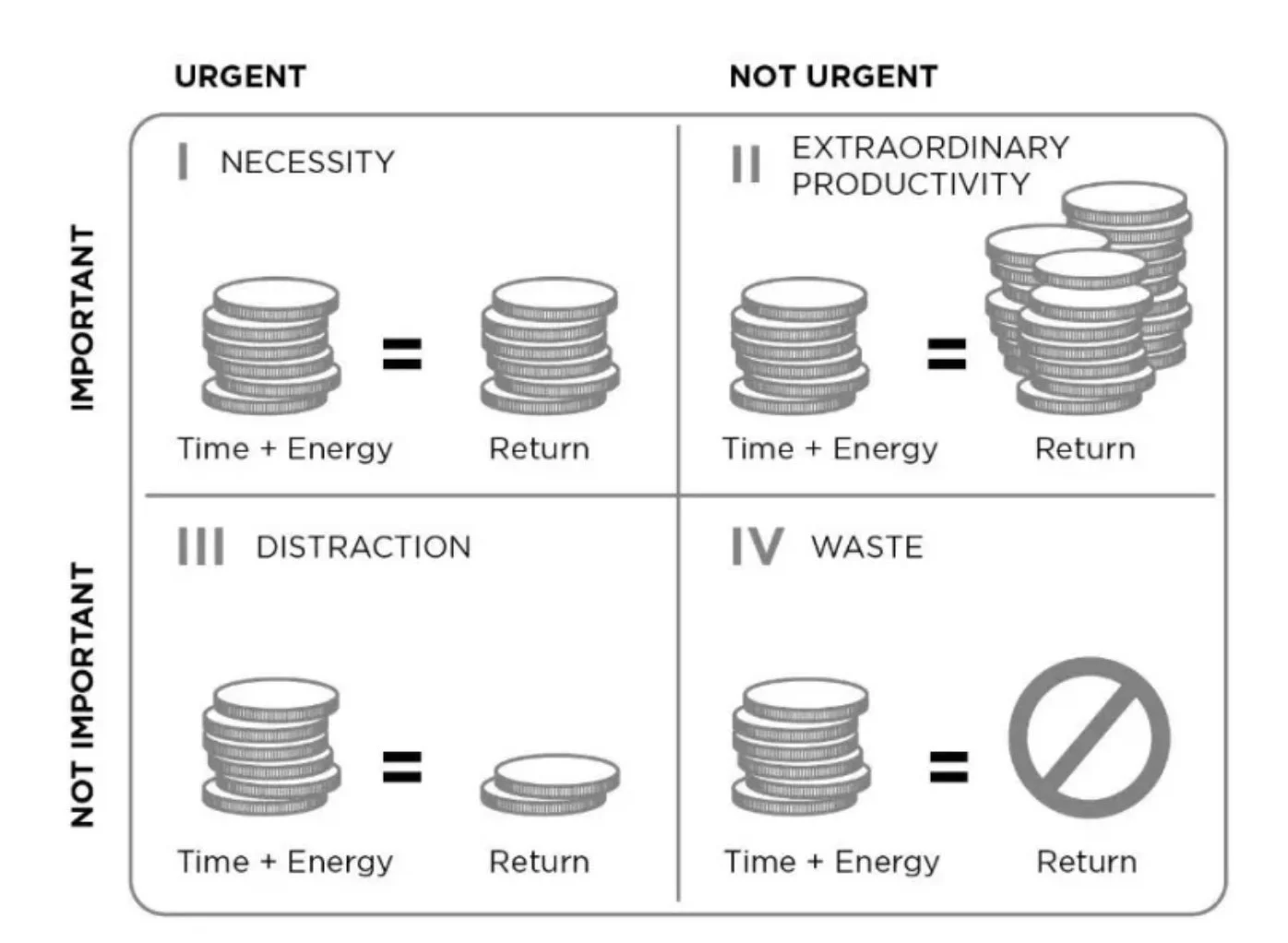
Taken from The 7 Habits of Highly Effective People by Stephen Covey.
busywork (some email, some phone calls)
pleasant activities
time wasters
Quadrant II: Tasks that are important but not urgent
healthy activities (brushing teeth, exercise, eating well)
building relationships
fulfilling activities
writing a book
The tasks that live here are where your most effective transformation occurs. They are not urgent, but they make all the difference in the long run. Often these are the things you know you should do but don’t always get around to. Unfortunately, we’re addicted to urgency, which makes it each to put off these tasks in favor of the other quadrants, especially I and III.
The Time Management Matrix for Writers
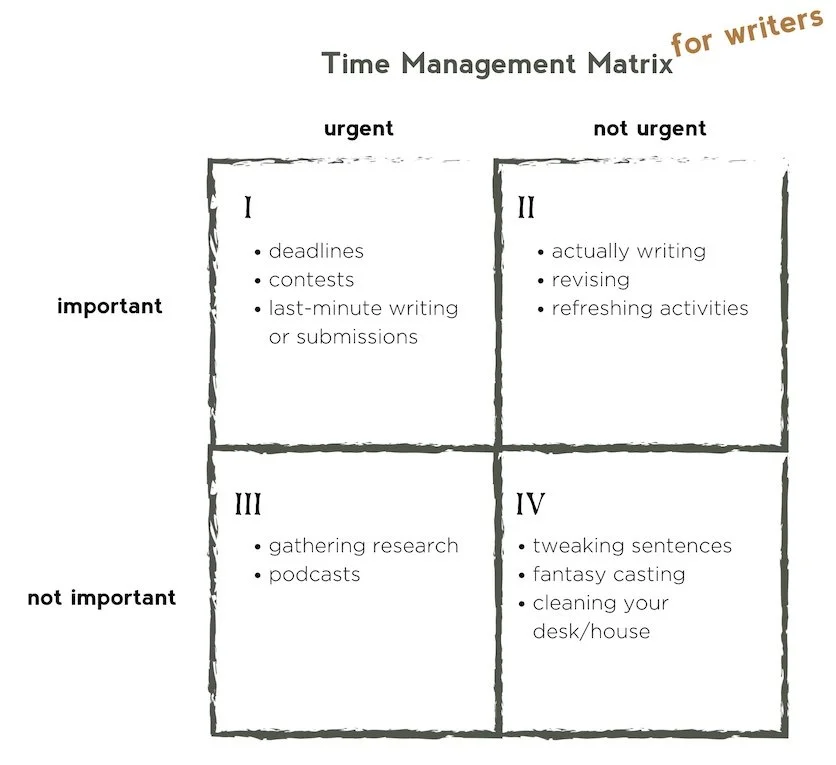
To talk more specifically about being an effective writer, we’ve adapted this chart somewhat. Remember, importance is calculated in terms of the time and effort and put in. Here’s what it can look like for authors:
Quadrant I: The producer
submitting to contests and other deadline-driven projects
sending a query before an agent closes their inbox
writing pages right before submitting them for critique
Quadrant III: The researcher
fitting in fits of sporadic writing
gathering more research
looking into newest books making lists
listening to podcasts by industry professionals (i.e., editors, agents, published authors)
Sometimes, these tasks are necessary, but remember, we’re talking about importance in terms of results. Too much here, and not much will actually end up on the page. It’s easy to feel these tasks are important, but they aren’t as important as actually writing, and often, the urgency is based on the priorities and expectations of others.
Quadrant IV: The daydreamer
thinking/talking about your book rather than actually spending time with it
making a fantasy cast for the movie adaptation
moving sentences and commas around
scrolling social media
Not much writing happens here, if any. Writers who spend too much time in this quadrant often feel guilty, which often leads to even more nothing on the page.
Quadrant II: The craftsman
regularly writing
outlining
drafting character and plot arcs
participating in critique groups
refilling your creative well with activities and recreation that refresh you
This is where your best work happens. Activities in this quadrant will sustain you in the long run, supporting your current story as well as the next one and the one after that.
Implementing Habit 3
Balance is what makes Habit 3 practical in the real world. For while Quadrant II is where your efforts are best rewarded, you often can’t ignore the urgency of Quadrants I and III. In addition to pressing daily matters we can’t ignore, it’s also virtually impossible for us to spend all our time in Quadrant II. Having a good sense of your priorities will help you identify what activities are serving you well and which ones might need to be minimized or eliminated.
Two questions to get started
To start using this habit, think about where you spend a lot of your time and which quadrants those activities would fall into. You can look at both Time Management Matrices or just the one for writers.
Ask yourself: How much time am I spending in each quadrant?
Then ask: What one thing, if I did it on a regular basis, would make the biggest positive difference in my writing?
Discipline is the strength of Quadrant II as well as Habit 3. Discipline is what makes the difference between a work-in-progress and a finished draft. Regularly prioritizing and revisiting your goals will make sure you’re always on the right track and moving towards results and growth.
Habit 3 helps you prioritize
If you put first things first, you ensure you’re using your time wisely. It’s true you can’t ignore the urgency of Quadrants I and III, but the more you lean into Quadrant II, the less crises you’ll have. You’ll already have pages to send or a pitch written down. You’ll be ready for that submission opportunity. You know what you need so you’re not stockpiling resources for a book that doesn’t even have a main character yet.
Habit 3 concludes the three private habits. Next time, we’ll shift into the public habits with Habit 4: Think Win/Win.
Are you stuck in Quadrant IV?
Adding and deleting sentences or words here and there but not feeling the confidence you need to put your work in the world? An editor can help with that. Your editors here at Ground Crew love helping authors like you rediscover your why, the passion that brought you to your current draft. Together, we can help you move your writing time back into Quadrant II so you can take off.
Thanks to Canva for the photo in this post!